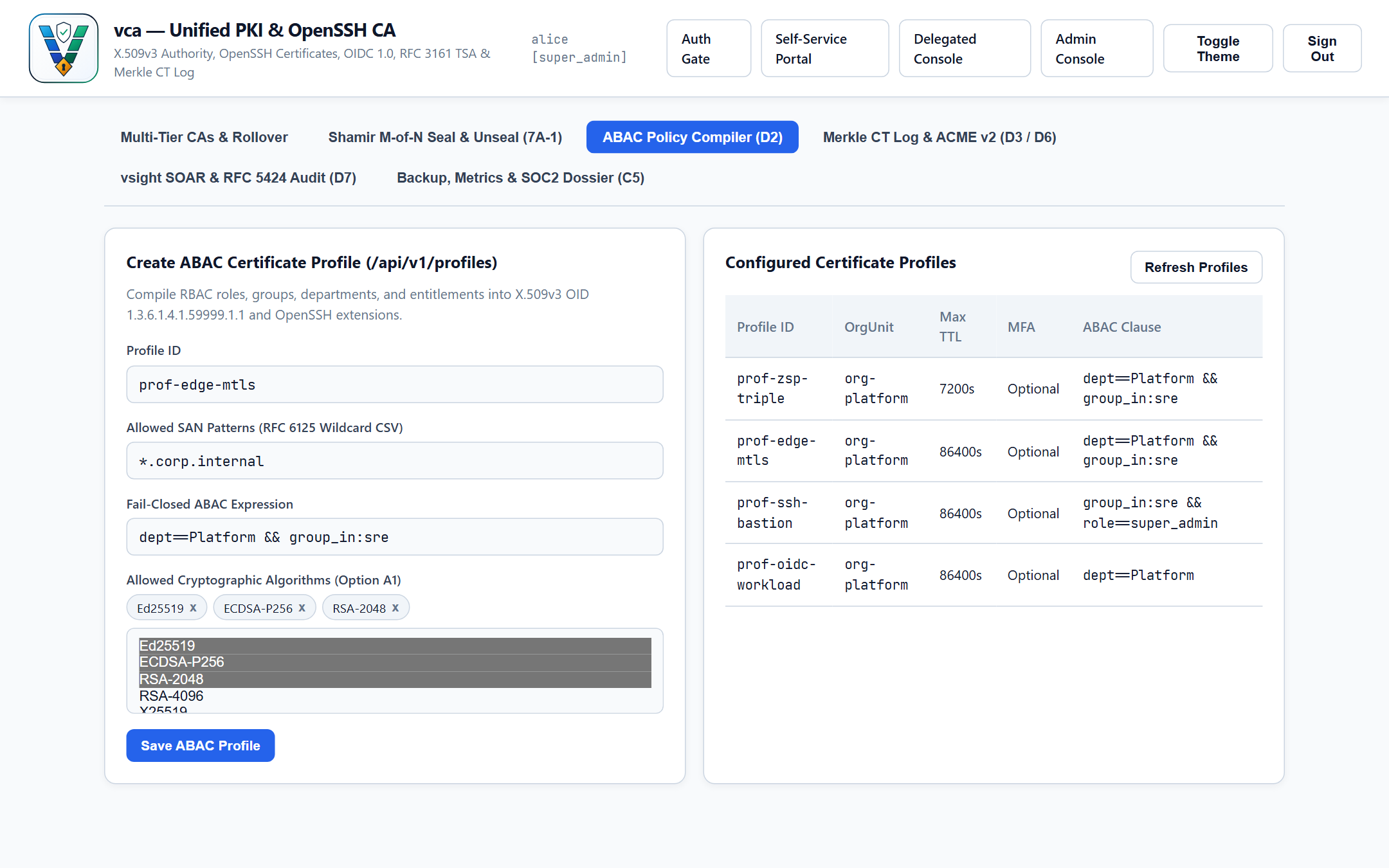
Enforces allowed SAN wildcard patterns, permitted DNS subtrees, and SSH principal whitelists
Clamps requested certificate lifetimes strictly to the matched profile max_ttl_seconds ceiling
PKI Engine
X.509 v3 DER Authority
ITU-T X.690 DERMulti-Tier X.509 v3
Component 4 of 6
Architectural Role & Purpose
Constructs, validates, and signs canonical X.509 v3 certificates, RFC 5280 CRLs, OCSP responses, and TSA tokens.
Contextual Description & System Interaction
Implements definite-length ASN.1 DER encoding and decoding natively with zero external crypto library dependencies.
Core Functionality & Security Mechanics
Supports Ed25519, Jacobian ECDSA-P256, blinded RSA-2048/3072/4096, and X25519 key agreement
Enforces critical BasicConstraints (pathLenConstraint) and Intermediate NameConstraints subtrees
Strips untrusted PKCS#10 CSR extensions and serves live CRL v2 and OCSP revocation status
SSH Engine
OpenSSH Cert Authority
OpenSSH Wire CodecSSHKRL Engine
Component 5 of 6
Architectural Role & Purpose
Signs short-lived OpenSSH user and host certificates, binary SSHKRL lists, and Git/artifact allowed_signers.
Contextual Description & System Interaction
Replaces static ~/.ssh/authorized_keys files and TOFU host prompts with short-lived cryptographic certificates.
Core Functionality & Security Mechanics
Issues ssh-ed25519-cert-v01, ecdsa-sha2-nistp256-cert-v01, and rsa-sha2-256/512-cert-v01
Sorts critical_options (source-address, force-command) and extensions lexicographically
Generates raw SSHKRL binary revocation artifacts for sshd RevokedKeys enforcement
Transparency & State
Merkle CT & Sealed Vault
RFC 6962 CT LogSharded MVCC Vault
Component 6 of 6
Architectural Role & Purpose
Seals CA keys in AES-256-GCM envelopes, records Merkle CT proofs, and persists sharded MVCC + CRC32 WAL state.
Contextual Description & System Interaction
Provides cryptographic non-repudiation for every issued credential and tamper-evident authority durability.
Core Functionality & Security Mechanics
Protects Master KEK with GF(2^8) Shamir M-of-N shares and instant RAM zeroization on seal
Appends every issued certificate to the RFC 6962 Merkle tree with O(log N) inclusion proofs
Persists Ed25519-signed hash-chained RFC 5424 audit logs across MVCC WAL, cluster, or SQLite
Core Capabilities
Audience
Capability
Operational Value
Developers & Engineers
Zero-Standing-Privilege SSH & mTLS (/ui/portal)
Sign client-generated PKCS#10 CSRs and ~/.ssh/id_*.pub keys without private key escrow, mint atomic Triple-Credential ZSP bundles (X.509 v3 + OpenSSH + vnet_tok_), and obtain 10-minute Fulcio-style keyless OIDC code-signing certificates.
Workload & Mesh Operators
Automated ACME v2, SPIFFE & Enrollment Tokens
Automate TLS and service-mesh certificate lifecycle via stateful RFC 8555 Private ACME v2 (/acme/v2/directory), RFC 8693 OAuth 2.0 Token Exchange, and SAN-scoped machine bootstrap tokens (vca_enroll_* and vca_pat_*).
Delegated Org Operators
Scoped Organizational Unit Governance (/ui/delegated)
Manage principals, scoped issuance profiles, enrollment tokens, and immediate certificate revocations strictly within assigned Organizational Unit boundaries (org_id).
PKI Administrators
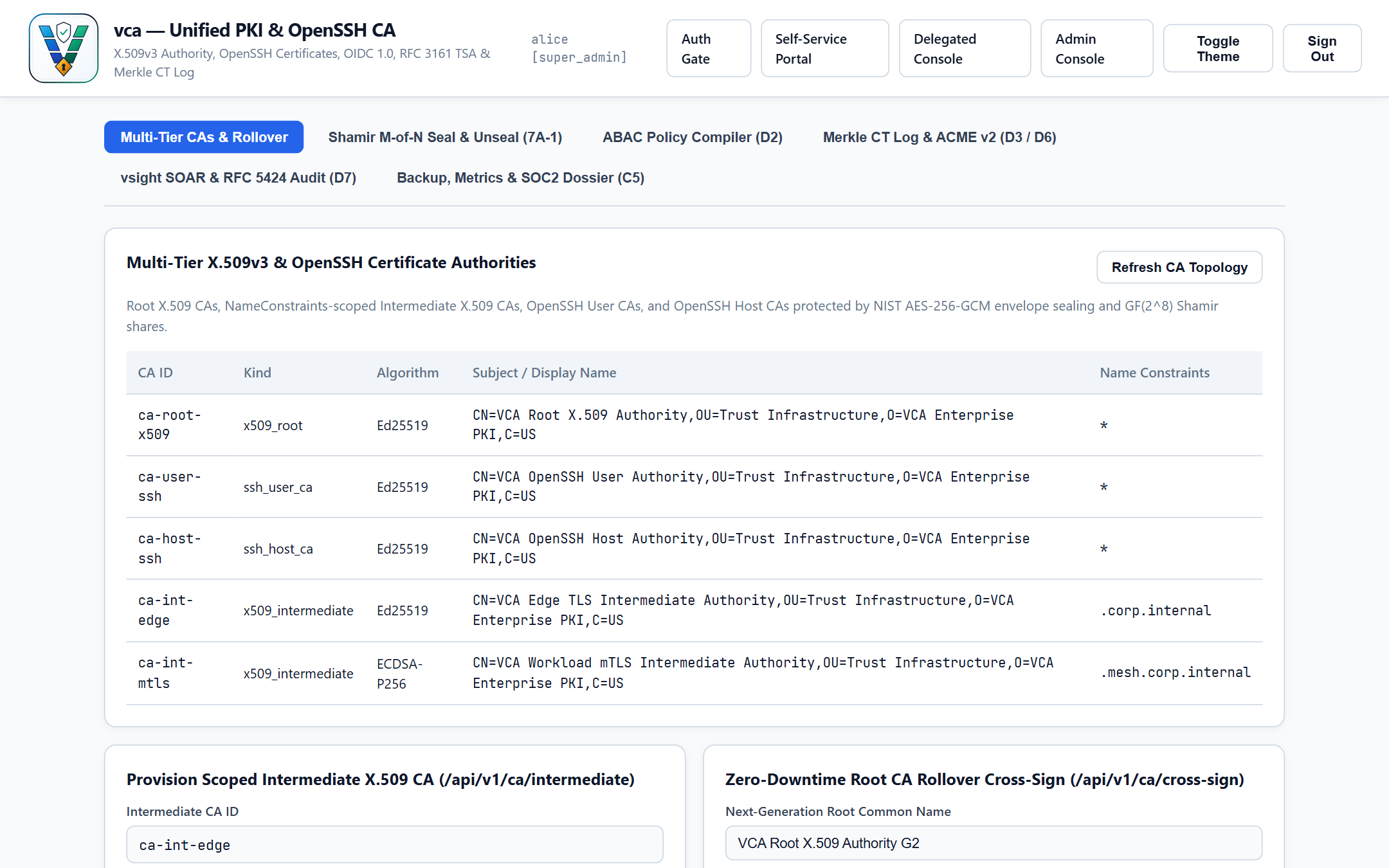
Multi-Tier CA Hierarchy, Shamir Quorum & Rollover (/ui/admin)
Govern Root CAs, RFC 5280 NameConstraints-scoped Intermediate CAs, and OpenSSH User/Host CAs protected by NIST SP 800-38D AES-256-GCM sealing, GF(2^8) M-of-N Shamir threshold ceremonies, and zero-downtime Root CA cross-signing.
Security & Compliance Teams
Merkle CT Log, Live CRL/OCSP/SSHKRL & SOAR
Verify O(log N) RFC 6962 Merkle inclusion proofs and Ed25519 Signed Tree Heads (STH), query live CRL v2 / RFC 6960 OCSP / binary SSHKRL, trigger closed-loop vsight SOAR containment, and export signed SOC2 / ISO 27001 compliance dossiers.
Live PKI Studio Preview
Identity & TOTP Authentication Gate (/ui/auth)
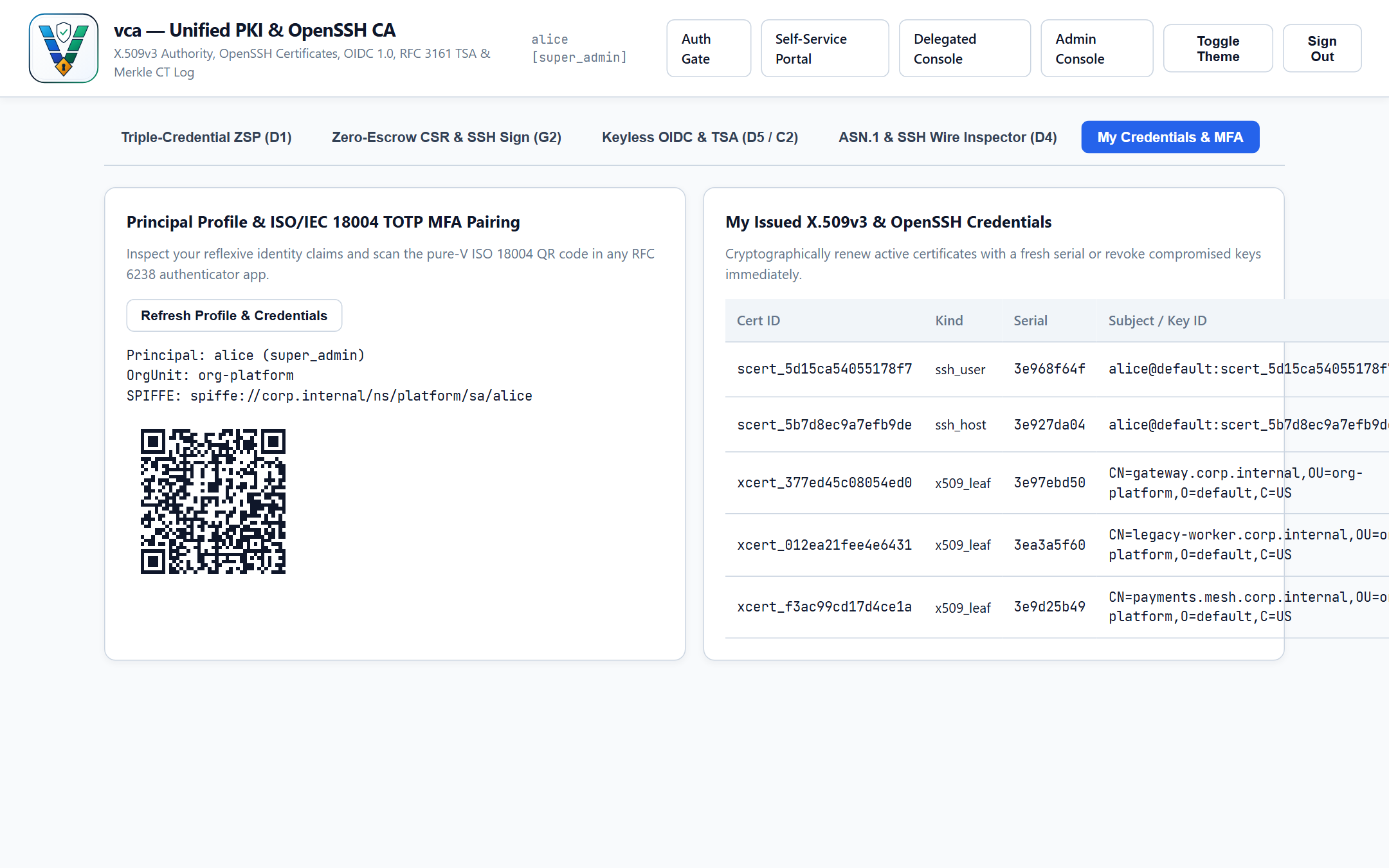
Self-Service Credentials, ISO 18004 MFA Pairing & Inventory (/ui/portal)
End-User Documentation Suite
Overview & Readme — Product overview, zero-trust PKI capabilities, Web Studio preview, and quickstart commands.
How-To Guide — Step-by-step recipes for offline Root + online Intermediate CA hierarchies, mTLS issuance, OpenSSH host/user signing, CT inclusion proof verification, and CRL/OCSP/SSHKRL revocation.
End-User Guide — Developer and workload workflows, Web Studio navigation, zero-escrow CSR submission, SSH certificate login, and ASN.1 DER / SSH wire inspection.
Operations & Use Cases — Production runbooks for zero-standing-privilege SSH bastions, service-mesh mTLS automation, CT log auditing, and incident SOAR revocation.
Configuration & CLI Reference — Complete CLI subcommand and flag catalog, vca.conf and environment variables, policy JSON schemas, and OpenAPI 3.1 REST endpoints.
Performance & Capacity Guide — Cryptographic signing throughput across Ed25519/ECDSA-P256/RSA, ASN.1 DER latency, Merkle CT append/proof latency, and WAL recovery metrics.
Master User Handbook — Single-volume consolidated compendium combining all End-User, How-To, Administrator, Operations, CLI, and Performance guides.
Quickstart
Run vca using the prebuilt native binary for your platform (vca.exe on Windows or ./vca on Linux and macOS):
BASH
# Display semantic version and cryptographic engine summary
./vca version

# Start the HTTP/1.1 OpenAPI Control Plane & 4-Workspace PKI Studio
./vca serve 127.0.0.1:8444 --data-dir data/vca --issuer http://127.0.0.1:8444

# Provision a NameConstraints-scoped Intermediate X.509 v3 CA
./vca ca init-intermediate \
  --cn "VCA Edge TLS Intermediate Authority" \
  --ca-id ca-int-edge \
  --domains ".corp.internal" \
  --out-chain edge_ca_chain.pem \
  --data-dir data/vca

# Issue a 3-tier X.509 v3 workload certificate chain (Leaf + Intermediate + Root)
./vca cert issue-x509 \
  --cn gateway.corp.internal \
  --san "gateway.corp.internal,api.corp.internal" \
  --ca-id ca-int-edge \
  --out-cert gateway_fullchain.pem \
  --out-key gateway.key \
  --data-dir data/vca

# Sign a short-lived OpenSSH user certificate without private key escrow
./vca ssh sign \
  --pubkey ~/.ssh/id_ed25519.pub \
  --principal "alice,sre-admin" \
  --type user \
  --ttl 28800 \
  --out ~/.ssh/id_ed25519-cert.pub \
  --data-dir data/vca
Open http://127.0.0.1:8444/ui/auth in your browser to access the Authentication Gate, Self-Service Portal, Delegated Operations Console, and Global Administrator Console.
vca — Step-by-Step How-To Guide
1. Bootstrapping an Offline Root & Online Scoped Intermediate CA Hierarchy
Production PKI deployments isolate the Root X.509 v3 trust anchor from daily leaf certificate signing by issuing Scoped Intermediate CAs restricted with RFC 5280 NameConstraints.
Step 1.1: Initialize the Authority Store and Root Hierarchy
Starting vca against a clean --data-dir automatically generates a 256-bit Master Key Encryption Key (master.kek), splits it into 2-of-3 GF(2^8) Shamir shares, and provisions sealed X.509 v3 Root (ca-root-x509), OpenSSH User (ca-user-ssh), and OpenSSH Host (ca-host-ssh) authorities under NIST SP 800-38D AES-256-GCM envelopes (ENC[vca-v2-gcm:...]).
Step 1.2: Provision Domain-Scoped Online Intermediate CAs
Create dedicated Intermediate CAs for public edge gateways and internal service-mesh workloads. Each Intermediate CA sets basicConstraints: critical, CA:TRUE, pathLenConstraint: 0 and enforces permittedSubtrees DNS boundaries:
Recipe 2.1: Direct CLI Issuance with Full 3-Tier PEM Chain
Issue a short-lived workload certificate signed by ca-int-mtls. vca appends an RFC 6962 Signed Certificate Timestamp (SCT) extension, logs the certificate in the Merkle CT tree, and writes the complete Leaf + Intermediate + Root PEM chain:
Recipe 2.2: Zero-Private-Key-Escrow PKCS#10 CSR Signing via REST API
Generate the private key locally on the workload host so private key material never crosses the network, then submit only the PKCS#10 CSR using either an interactive Bearer JWT or a SAN-scoped enrollment token (vca_enroll_...):
vca verifies the CSR Proof-of-Possession signature, strips all untrusted client CSR extensions, enforces RFC 6125 single-label wildcard SAN rules and Intermediate NameConstraints, and returns certificate_pem, certificate_chain_pem, serial_hex, and sct_leaf_hash.
3. Signing Short-Lived OpenSSH User & Host Certificates
vca implements OpenSSH PROTOCOL.certkeys across ssh-ed25519-cert-v01@openssh.com, rsa-sha2-256-cert-v01@openssh.com, and ecdsa-sha2-nistp256-cert-v01@openssh.com without ever escrowing SSH private keys.
Step 3.1: Configure OpenSSH Daemons & Clients to Trust vca
BASH
# Export TrustedUserCAKeys and @cert-authority known_hosts entries
curl -sS http://127.0.0.1:8444/api/v1/ssh/ca-keys
On target Linux servers (./config/ssh/sshd_config), trust the vca User SSH CA and install its host certificate:
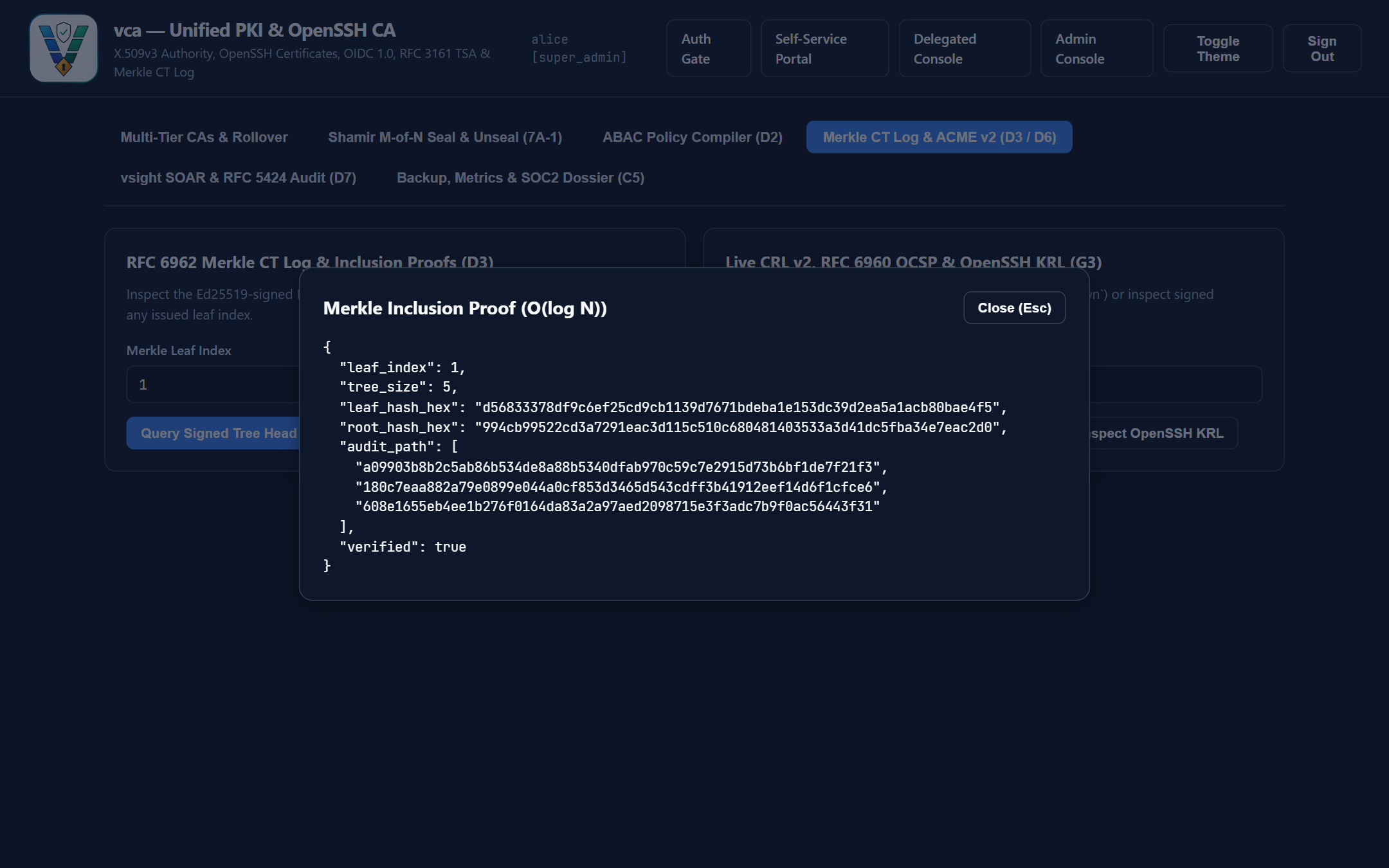
Every X.509 v3 certificate issued by vca (standard CSR, Triple-Credential ZSP bundle, ACME v2 finalize, or Keyless OIDC signing) is appended to an RFC 6962 SHA-256 Merkle binary tree.
BASH
# 1. Fetch the Ed25519-signed Merkle Signed Tree Head (STH)
curl -sS http://127.0.0.1:8444/api/v1/ct/v1/get-sth

# 2. Request and verify an O(log N) Merkle inclusion proof for leaf index 1
curl -sS "http://127.0.0.1:8444/api/v1/ct/v1/get-proof-by-index?index=1"
When a workload key or developer laptop is compromised, revoke the credential immediately by cert_id with an RFC 5280 revocation reason (keyCompromise, cessationOfOperation, superseded, or privilegeWithdrawn):
Step 6.1: Serve vca Natively over HTTPS or Mutual TLS (mTLS)
Start vca directly over TLS without an external reverse proxy using either explicit PEM files or an ephemeral auto-provisioned ECDSA-P256 bundle:
BASH
# Quick native HTTPS with an auto-provisioned ECDSA-P256 certificate
./vca serve 0.0.0.0:8444 --tls-auto --data-dir ./data

# Production mTLS enforcing client certificates signed by your CA bundle
./vca serve 0.0.0.0:8444 \
  --tls-cert ./certs/vca_server.pem \
  --tls-key ./certs/vca_server.key \
  --tls-client-ca ./certs/vca_root_ca.pem \
  --data-dir ./data
Step 6.2: Automated Network & MDM Device Enrollment via EST (RFC 7030) and SCEP (RFC 8894)
BASH
# 1. Fetch the RFC 7030 EST PKCS#7 certs-only CA bundle
curl -sS https://pki.corp.internal/.well-known/est/cacerts -o cacerts.p7b.b64

# 2. Enroll a network appliance via EST simpleenroll (HTTP Basic or Bearer / vca_enroll_* token)
curl -sS -X POST https://pki.corp.internal/.well-known/est/simpleenroll \
  -u "alice:vca-secret-2026" \
  -H "Content-Type: application/pkcs10" \
  --data-binary @device.csr.b64 \
  -o device.p7b.b64

# 3. Query SCEP capabilities and CA certificate for MDM / router clients
curl -sS "https://pki.corp.internal/scep?operation=GetCACaps"
curl -sS "https://pki.corp.internal/scep?operation=GetCACert" -o ca.der
vca — End-User & Developer Guide
1. Navigating the Role-Separated PKI Web Studio
vca provides four role-separated browser workspaces served directly by the authority daemon (http://127.0.0.1:8444/ui/*). Each workspace defaults to crisp Institutional Light Mode (data-theme="light") with a persistent 1-click Dark Mode toggle in the top header bar:
Workspace Path
Target Persona
Primary Capabilities
/ui/auth
All Principals
Username + PBKDF2 password + 6-digit RFC 6238 TOTP sign-in, plus OIDC 1.0 + PKCE and ACME v2 endpoint discovery.
/ui/portal
Developers & Workloads (member)
Triple-Credential ZSP bundles, zero-escrow PKCS#10 CSR and SSH .pub signing, keyless OIDC code-signing, RFC 3161 timestamping, ASN.1 DER / SSH wire inspection, TOTP QR pairing, and personal credential renewal/revocation.
/ui/delegated
OrgUnit Leads (delegated_admin)
Scoped certificate inventory, OrgUnit principal provisioning, and SAN-locked machine enrollment token minting within the caller's org_id.
/ui/admin
PKI Governors (super_admin, global_admin)
Multi-tier Root/Intermediate/SSH CA topology, Shamir M-of-N seal/unseal ceremonies, ABAC policy profiles, Merkle CT log proofs, live CRL/OCSP/SSHKRL, vsight SOAR containment, and encrypted backups.
2. Signing In & Pairing TOTP Multi-Factor Authentication
Open /ui/auth in your browser.
Enter your username, password, and (when MFA is enabled on your account) the current 6-digit TOTP verification code from your authenticator app, then click Sign In & Mint EdDSA Session.
Navigate to Self-Service Portal -> My Credentials & MFA and click Refresh Profile & Credentials to view your verified SPIFFE ID (spiffe://<trust-domain>/ns/<org>/sa/<user>) and scan your offline ISO/IEC 18004 vector SVG QR code.
3. Minting Atomic Triple-Credential ZSP Bundles
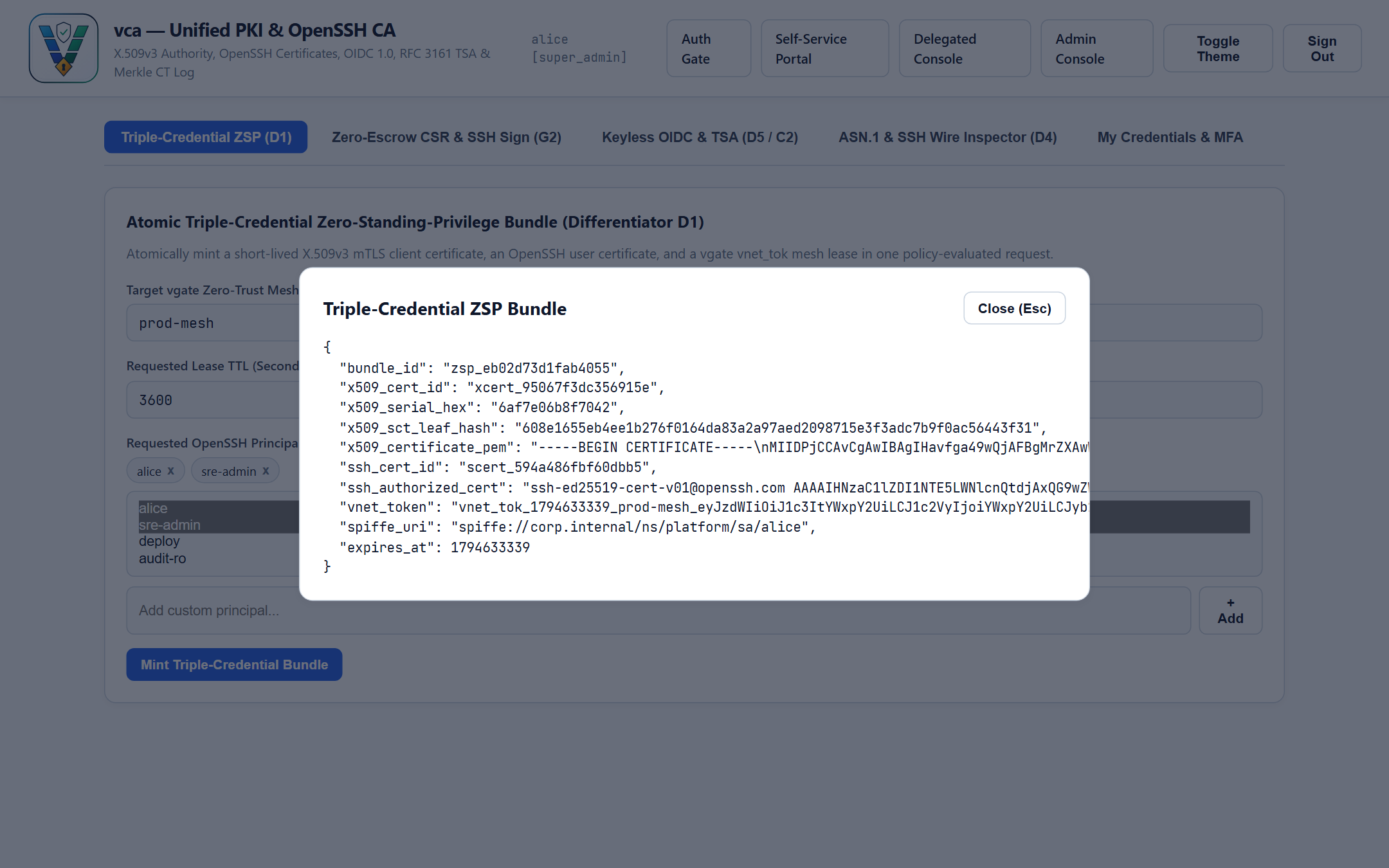
Instead of juggling separate mTLS certificates, static SSH keys, and VPN configurations, developers can mint a short-lived Triple-Credential Zero-Standing-Privilege (ZSP) Bundle from /ui/portal (Triple-Credential ZSP tab):
Set the Target vgate Zero-Trust Mesh Network (for example, prod-mesh) and Requested Lease TTL (for example, 3600 seconds).
Select one or more authorized OpenSSH Principals (alice, sre-admin, deploy) using the multi-select chip selector.
Click Mint Triple-Credential Bundle.
The Lightbox modal displays a single JSON bundle containing:
x509_certificate_pem — Short-lived X.509 v3 mTLS client certificate bound to your SPIFFE URI and ABAC claims (OID 1.3.6.1.4.1.59999.1.1) with an embedded Merkle CT SCT.
ssh_authorized_cert — Short-lived OpenSSH User certificate (ssh-ed25519-cert-v01@openssh.com) carrying your approved principals and permit-pty / permit-port-forwarding extensions.
4. Submitting Zero-Escrow CSRs & Logging In with OpenSSH Certificates
4.1 Zero-Escrow PKCS#10 CSR Submission
When your private key must remain on your workstation, HSM, or container volume:
Generate an Ed25519, ECDSA-P256, or RSA-2048/4096 keypair and PKCS#10 CSR locally.
Open Self-Service Portal -> Zero-Escrow CSR & SSH Sign.
Enter your requested DNS Subject Alternative Names (for example, workload.corp.internal), paste the -----BEGIN CERTIFICATE REQUEST----- block, and click Sign PKCS#10 CSR.
Save the returned 3-tier certificate_chain_pem alongside your local private key.
Copy the contents of your local public key (~/.ssh/id_ed25519.pub)—never your private key.
In Zero-Escrow CSR & SSH Sign, paste the .pub line, keep User Certificate (SSH_CERT_TYPE_USER = 1) selected, and click Sign OpenSSH Public Key (or run vca ssh sign --pubkey ~/.ssh/id_ed25519.pub --principal alice --out ~/.ssh/id_ed25519-cert.pub).
Write the authorized_cert_line to ~/.ssh/id_ed25519-cert.pub next to ~/.ssh/id_ed25519.
Connect directly with standard OpenSSH:
BASH
# Inspect your issued certificate validity, serial, principals, and CA fingerprint
ssh-keygen -L -f ~/.ssh/id_ed25519-cert.pub

# Connect to any host trusting the vca OpenSSH User CA
ssh alice@bastion01.corp.internal
OpenSSH automatically presents ~/.ssh/id_ed25519-cert.pub alongside ~/.ssh/id_ed25519 without requiring any static ~/.ssh/authorized_keys entry on the remote host.
Click Mint 10-Minute Keyless X.509 v3 Cert to exchange your active OIDC session for a Fulcio-style ephemeral signing certificate bound to your SPIFFE identity and logged permanently in the Merkle CT tree.
Click Issue RFC 3161 Timestamp Token over any 64-character SHA-256 release artifact digest (POST /api/v1/tsa/timestamp) so verifiers can prove the signature existed while the 10-minute ephemeral certificate was valid.
Click Export OpenSSH allowed_signers (GET /api/v1/ssh/allowed-signers) to verify Git tags and release bundles using ssh-keygen -Y verify.
5.2 Visual ASN.1 DER & OpenSSH Wire Byte-Tree Inspector
Open ASN.1 & SSH Wire Inspector in /ui/portal (or run ./vca inspect <file>):
Paste any X.509 PEM certificate, PKCS#10 CSR, RFC 3161 Timestamp Token, or OpenSSH *-cert-v01@openssh.com line and click Inspect Byte-Tree in Lightbox.
Review exact byte offsets, definite-length TLV lengths, nesting depths, OIDs, SANs, or OpenSSH PROTOCOL.certkeys wire fields before deploying credentials to production.
6. Renewing & Revoking Personal Credentials
In My Credentials & MFA, every active credential owned by your principal lists two one-click actions:
Renew (POST /api/v1/self/renew) — Re-evaluates policy and re-signs the public key with a fresh cryptographic serial number and updated validity window while preserving historical immutability of the prior certificate record.
Revoke (POST /api/v1/certificates/revoke) — Marks the credential revoked immediately across live OCSP, CRL v2, and OpenSSH KRL endpoints.
vca — PKI Administrator Guide
1. PKI Hierarchy Governance & Role Separation
vca enforces strict three-tier Role-Based Access Control (RBAC) combined with Organizational Unit (org_id) tenancy boundaries:
Role
Scope
Permitted Governance Actions
super_admin / global_admin
Global Authority
Provision Scoped Intermediate CAs, execute Root CA cross-signing, trigger RAM seal / Shamir M-of-N unseal ceremonies, manage all OrgUnits/profiles/users, run SOAR quarantines, export encrypted VCA_BACKUP_V2 snapshots, and generate SOC2 dossiers.
delegated_admin / org_admin
Assigned org_id Only
View OrgUnit certificates, create users and ABAC profiles strictly within their own org_id (cannot promote any user to global_admin), mint scoped enrollment tokens, and revoke OrgUnit certificates.
member
Reflexive Self-Service
Mint personal/workload certificates permitted by ABAC profiles, inspect artifacts, and renew or revoke only certificates they personally own.
Navigate to /ui/admin (Multi-Tier CAs & Rollover tab) to inspect active signing authorities:
Root X.509 v3 Authority (x509_root) — Trust anchor with CA:TRUE, pathLenConstraint: 2, sealed at rest using NIST SP 800-38D AES-256-GCM (ENC[vca-v2-gcm:<iv>:<tag>:<ciphertext>]).
Scoped Intermediate X.509 v3 Authorities (x509_intermediate) — Signed by the Root CA with CA:TRUE, pathLenConstraint: 0 and critical RFC 5280 NameConstraints (permittedSubtrees), ensuring an edge Intermediate CA scoped to .corp.internal can never issue certificates for .prod.payments or external domains.
OpenSSH User & Host Authorities (ssh_user_ca, ssh_host_ca) — Separate signing authorities for human/automation SSH user principals (cert_type = 1) and server host identities (cert_type = 2). Note that issuing an OpenSSH Host certificate requires an administrative role or a pre-authorized host enrollment token.
On initial bootstrap, vca generates a 32-byte CSPRNG master.kek and splits it into 2-of-3 Shamir Secret Shares over $\text{GF}(2^8)$ (x^8 + x^4 + x^3 + x + 1). Distribute each vca_share_2of3_<idx>_<hex> token to a separate key custodian.
During a security incident or maintenance window, seal the authority in RAM immediately:
BASH
# Zero the 256-bit Master KEK and unsealed CA key cache in RAM
curl -sS -X POST http://127.0.0.1:8444/api/v1/ca/seal \
  -H "Authorization: Bearer ${ADMIN_JWT}"
While sealed ("is_sealed": true on /api/v1/health), all signing endpoints fail closed with 503 Service Unavailable. Reconstruct master.kek in memory by submitting threshold shares via /ui/admin (Shamir M-of-N Seal & Unseal tab) or the API:
When rotating from Root Generation 1 (G1) to Root Generation 2 (G2), issue a Cross-Signed Bridge Certificate (POST /api/v1/ca/cross-sign) whose Subject and SubjectPublicKeyInfo belong to G2 while Issuer and signature belong to G1:
Unrecognized ABAC Clauses Fail Closed: Any unknown attribute key or malformed operator immediately denies issuance (403 Forbidden).
RFC 6125 Single-Label Wildcard Enforcement: A pattern of *.corp.internal matches api.corp.internal (true), but strictly rejects multi-label subdomains such as deep.api.corp.internal (false) and bare apex corp.internal (false).
Cryptographic Claims Compilation: Approved principal attributes (org_id, department, groups, entitlements) are compiled directly into X.509 v3 extension OID 1.3.6.1.4.1.59999.1.1 and OpenSSH certificate extension vca-abac-claims@vca.internal so downstream proxies verify authorization offline.
5. OIDC 1.0 Federation & External PDP Integration
Built-In OIDC 1.0 + PKCE (S256) & RFC 8693 STS:
Relying parties discover endpoints via GET /.well-known/openid-configuration and Ed25519 public keys (OKP) via GET /.well-known/jwks.json.
Workloads holding a valid OIDC JWT can call POST /api/v1/oidc/token with grant_type = "urn:ietf:params:oauth:grant-type:token-exchange" to obtain short-lived X.509 v3 certificates bound to their spiffe_id claim.
Upstream vwarden Policy Decision Point (--vwarden-pdp):
Configure vwarden_pdp_url = https://vwarden.corp.internal in vca.conf (or --vwarden-pdp) so vca consults POST /access/v1/evaluate on central vwarden clusters before minting privileged production credentials.
Closed-Loop vsight SIEM & SOAR (--vsight-syslog):
Configure vsight_syslog_addr = 10.10.0.25:6514 to stream Ed25519-signed RFC 5424 audit lines over TCP, and allow vsight to invoke POST /api/v1/soar/quarantine authenticated via constant-time X-Vsight-Signature HMAC-SHA256 headers.
In default vprevail mode, vca persists mutations across 64 FNV-1a shards with {org_id} hash-tag co-location into segmented 32-byte IEEE CRC32 binary write-ahead logs (00000000000000000000.log), 24-byte .idx sparse indexes, and LZ4-compressed .snap checkpoints. On cold start or crash recovery:
vca loads the latest verified .snap checkpoint, replays subsequent .log frames, automatically truncates any torn trailing bytes, and rolls back any uncommitted TX_BEGIN frame lacking a matching TX_COMMIT.
Merkle CT leaves (ct_leaf_0..N) are deterministically rehydrated so tree hashes remain continuous across restarts.
Export a complete AES-256-GCM encrypted backup containing all CAs (with sealed private keys), users, OrgUnits, ABAC profiles, quorum ceremonies, and issued/revoked certificate records:
BASH
# Export encrypted VCA_BACKUP_V2 snapshot via CLI or REST API
./vca backup --out ./backups/vca-$(date +%F).backup.json --data-dir ./data

# Restore encrypted envelope onto a recovery node sharing the same master.kek
curl -sS -X POST http://127.0.0.1:8444/api/v1/admin/restore \
  -H "Authorization: Bearer ${ADMIN_JWT}" \
  -H "Content-Type: application/json" \
  -d '{"encrypted_envelope": "ENC[vca-v2-gcm:...]"}'
6.3 Generating Signed Compliance Dossiers & OpenMetrics
Before exposing vca in production environments, enable strict startup validation (--prod), sealed-on-boot custody (--start-sealed), and native TLS/mTLS termination:
Reference deployment templates are bundled under deploy/:
deploy/vca.service: Hardened systemd unit (NoNewPrivileges, ProtectSystem=strict, PrivateTmp, CAP_NET_BIND_SERVICE).
deploy/Containerfile: Non-root (uid 10001) minimal runtime image with healthcheck.
deploy/k8s-deployment.yaml: Kubernetes Deployment with readinessProbe and livenessProbe targeting HTTPS /api/v1/health and Secret-backed VCA_* credentials.
Platform engineers require on-demand interactive shell access (sre-admin) to production Linux hosts behind a vgate zero-trust bastion without leaving permanent public keys in ~/.ssh/authorized_keys or long-lived VPN credentials on laptops.
Step-by-Step Execution
Configure Target Hosts Once: Distribute the vca User SSH CA public key (GET /api/v1/ssh/ca-keys) to ./certs/ssh/vca_user_ca.pub and configure ./config/ssh/sshd_config with TrustedUserCAKeys ./certs/ssh/vca_user_ca.pub and RevokedKeys ./certs/ssh/vca_revoked.krl.
Authenticate with MFA: Engineer authenticates against vca (POST /api/v1/auth/login with 6-digit TOTP code) or via federated OIDC 1.0 PKCE (POST /api/v1/oidc/authorize -> POST /api/v1/oidc/token).
Connect & Auto-Expire: The engineer presents vnet_token to vgate, establishes mTLS using x509_certificate_pem, and connects via ssh -i ~/.ssh/id_ed25519 sre-admin@db01.corp.internal. After 3600 seconds, all three credentials expire cryptographically with zero cleanup scripts required.
Edge ingress proxies (vgate, vsite) and internal microservices require automated X.509 v3 certificate provisioning and zero-downtime renewal without human intervention or private key escrow.
# 1. Obtain fresh anti-replay nonce and register ACME client account
NONCE_JSON=$(curl -sS https://pki.corp.internal/acme/v2/new-nonce)
curl -sS -X POST https://pki.corp.internal/acme/v2/new-acct \
  -H "Content-Type: application/json" \
  -d '{"contact": "mailto:platform-ops@corp.internal"}'

# 2. Submit certificate order (unauthenticated orders start in "pending" state)
ORDER_JSON=$(curl -sS -X POST https://pki.corp.internal/acme/v2/new-order \
  -H "Content-Type: application/json" \
  -d '{"domains": ["ingress01.corp.internal"]}')

# 3. Validate domain ownership challenge (transitions order to "ready")
curl -sS -X POST https://pki.corp.internal/acme/v2/chall \
  -H "Content-Type: application/json" \
  -d '{"order_id": "ord_...", "challenge_token": "chall_..."}'

# 4. Finalize with local PKCS#10 CSR (CN must match ordered domain) & fetch PEM chain
FINAL_JSON=$(curl -sS -X POST https://pki.corp.internal/acme/v2/finalize \
  -H "Content-Type: application/json" \
  -d '{"order_id": "ord_...", "csr_pem": "-----BEGIN CERTIFICATE REQUEST-----\n..."}')

curl -sS "https://pki.corp.internal/acme/v2/cert?cert_id=xcert_..." -o ../vgate/certs/fullchain.pem
Option B: Workload Bootstrap via Scoped Enrollment Token (vca_pat_*)
For headless sidecars that cannot answer external HTTP challenges, mint a SAN-locked reusable machine PAT (max_uses: 50) restricted to *.mesh.corp.internal and invoke POST /api/v1/self/x509-sign on startup and POST /api/v1/self/renew at 70% of TTL.
Security auditors and CI/CD release pipelines (vstore, vllm, vvm, vkbm) require mathematical proof that every signing certificate is recorded in an append-only Merkle tree and that release artifacts were signed while the ephemeral certificate was valid.
Step-by-Step Execution
BASH
# 1. CI runner exchanges OIDC workload JWT for a 10-minute keyless signing certificate + SCT
curl -sS -X POST https://pki.corp.internal/api/v1/self/keyless-sign \
  -H "Authorization: Bearer ${CI_OIDC_JWT}" > keyless_cert.json

# 2. Stamp the compiled release binary SHA-256 with an RFC 3161 TSTInfo Timestamp Token
./vca tsa sign \
  --file release/app-linux-x64.tar.gz \
  --nonce 20261114cafe \
  --out release/app-linux-x64.tsr.pem \
  --data-dir ./data

# 3. Downstream consumers verify the RFC 3161 Timestamp Token offline/online
./vca tsa verify \
  --token release/app-linux-x64.tsr.pem \
  --file release/app-linux-x64.tar.gz \
  --data-dir ./data

# 4. Auditors verify the Ed25519 Signed Tree Head (STH) and O(log N) Merkle inclusion proof
curl -sS https://pki.corp.internal/api/v1/ct/v1/get-sth
curl -sS "https://pki.corp.internal/api/v1/ct/v1/get-proof-by-index?index=0"
vsight Endpoint Detection & Response (EDR) detects anomalous lateral movement originating from principal usr-alice, or operators detect an active intrusion targeting a regional PKI node.
Step-by-Step Containment
Automated Closed-Loop Principal Quarantine (POST /api/v1/soar/quarantine):
vsight dispatches an HMAC-SHA256 authenticated webhook (X-Vsight-Signature) or an administrator triggers quarantine from /ui/admin (vsight SOAR & RFC 5424 Audit tab):
vca atomically revokes every active X.509 v3 and OpenSSH credential issued to usr-alice, updates live OCSP/CRL/SSHKRL responders, appends an Ed25519-signed SHA-256 hash-chained audit event, and emits an RFC 5424 syslog alert.
Propagate Revocation Lists Immediately:
Edge gateways refresh GET /api/v1/x509/crl?format=pem and SSH bastions refresh GET /api/v1/ssh/krl?format=raw.
Confirm "chain_integrity_verified": true across all rolling SHA-256 event hashes and Ed25519 non-repudiation signatures.
Emergency Host Seal (If Authority Host Is Threatened):
Invoke POST /api/v1/ca/seal to zero master.kek and all cached CA signing keys in RAM immediately until incident responders complete forensic verification and conduct a 2-of-3 Shamir unseal ceremony.
vca — Configuration, CLI & REST API Reference
1. CLI Subcommand & Flag Reference
Invoke vca (vca.exe on Windows, ./vca on Linux and macOS) with any of the server, governance, or workload subcommands below.
Provisions an RFC 5280 NameConstraints-scoped Intermediate X.509 v3 CA signed by ca-root-x509, persists sealed keys, writes Intermediate + Root PEM to --out-chain, and prints JSON summary.
Generates a keypair, signs an X.509 v3 leaf certificate with embedded Merkle CT SCT, writes the 3-tier PEM chain (Leaf + Intermediate + Root) to --out-cert and PKCS#8 private key to --out-key.
Short-lived zero-trust credentials (10-minute keyless signing certificates, 1-hour Triple-Credential ZSP bundles, and 4-hour service-mesh mTLS leaves) increase certificate issuance velocity by 100x compared to legacy 1-year PKI deployments. vca sustains high-throughput signing with sub-millisecond read paths through five architectural optimizations:
Native Compiled Execution & Bounded Buffers: Compiles directly to native x86_64/ARM64 machine code with zero external TLS/ASN.1 shared-library marshaling overhead and strict HTTP/1.1 connection caps (10s socket timeouts, 32 KiB header cap, 4 MiB body cap).
Zero-Allocation Definite-Length ASN.1 DER Codec: Encodes canonical ITU-T X.690 DER TBSCertificate, CertificateList, OCSPResponse, and RFC 3161 TSTInfo byte buffers in deterministic linear passes capped at 256 KiB and nesting depth 16.
Accelerated Elliptic-Curve & RSA-CRT Signing:
Ed25519 (RFC 8032 / RFC 8410) executes deterministic signature generation in tens of microseconds and is recommended as the primary high-velocity algorithm for Root/Intermediate X.509 CAs, OpenSSH User/Host CAs, Merkle CT STH signatures, and OIDC JWTs.
RSA-2048 / RSA-4096 (RFC 8017) uses 9-integer Chinese Remainder Theorem (RSA-CRT) private-key acceleration with cryptographic blinding and Bellcore fault-injection verification before emitting signatures.
Immutable Power-of-Two Merkle Subtree Cache: Complete binary subtrees in the RFC 6962 Certificate Transparency log are cached immutably on append, reducing both Signed Tree Head (STH) root computation and inclusion proof generation from $O(N)$ to $O(\log_2 N)$ SHA-256 hashes.
64-Shard MVCC Store + Segmented LZ4 WAL: Hot queries (OCSP, JWKS, get-sth, get-proof-by-index, profile lookups) execute in memory across 64 FNV-1a shards with {org_id} shard affinity, while mutations append 32-byte IEEE CRC32 binary WAL frames with LZ4-compressed .snap checkpoints.
2. Cryptographic Signing, DER & Issuance Benchmarks
Representative single-node production (-prod) measurements on an 8-vCPU / 16 GiB x86_64 server (vprevail 64-shard MVCC + NVMe WAL):
10,000-round salted PBKDF2 + TOTP + EdDSA JWT mint
4.20 ms
8.90 ms
~ 850 logins/s (rate-limited per account)
3. Merkle CT Tree Scaling & WAL Recovery Metrics
Corpus Scale (Issued Certificates & CT Leaves)
On-Disk LZ4 .snap Size
Active RAM Footprint
Cold-Start Snapshot + WAL Recovery Time
Merkle Inclusion Proof Depth ($\lceil \log_2 N \rceil$)
10,000 credentials
~ 3.8 MiB
~ 28 MiB
~ 18 ms
14 SHA-256 sibling nodes (448 B)
100,000 credentials
~ 36 MiB
~ 195 MiB
~ 145 ms
17 SHA-256 sibling nodes (544 B)
1,000,000 credentials
~ 350 MiB
~ 1.65 GiB
~ 1.35 s
20 SHA-256 sibling nodes (640 B)
4. Production Sizing & Algorithm Selection Guidelines
Default to Ed25519 for Internal mTLS, SSH, and ZSP Leases:
Ed25519 produces compact 64-byte signatures and 32-byte public keys, runs over 3x faster than ECDSA-P256 and 6x faster than RSA-2048, and is natively supported by TLS 1.3 stacks, Go/Rust/V services, and OpenSSH 6.5+.
Use ECDSA-P256 Intermediate CAs for Browser & LegacyFIPS TLS Gateways:
Provision a dedicated ECDSA-P256 Scoped Intermediate CA (--alg ECDSA-P256) when issuing certificates consumed by legacy Java, Windows SChannel, or browser clients that expect ecdsa-with-SHA256.
Place --data-dir on Local NVMe SSDs:
Segmented .log WAL appends (64 MiB segment rotation) and atomic .snap checkpoints achieve lowest p99 tail latency on local NVMe storage. For multi-node high availability, run --mode vprevail_cluster against a replicated vprevail quorum.
Automate CRL / SSHKRL Edge Caching:
Edge load balancers and SSH bastions should poll GET /api/v1/x509/crl?format=pem and GET /api/v1/ssh/krl?format=raw every 60–300 seconds, reserving synchronous POST /api/v1/x509/ocsp queries for high-value administrative endpoints.
Enforces allowed SAN wildcard patterns, permitted DNS subtrees, and SSH principal whitelists
Clamps requested certificate lifetimes strictly to the matched profile max_ttl_seconds ceiling
PKI Engine
X.509 v3 DER Authority
ITU-T X.690 DERMulti-Tier X.509 v3
Component 4 of 6
Architectural Role & Purpose
Constructs, validates, and signs canonical X.509 v3 certificates, RFC 5280 CRLs, OCSP responses, and TSA tokens.
Contextual Description & System Interaction
Implements definite-length ASN.1 DER encoding and decoding natively with zero external crypto library dependencies.
Core Functionality & Security Mechanics
Supports Ed25519, Jacobian ECDSA-P256, blinded RSA-2048/3072/4096, and X25519 key agreement
Enforces critical BasicConstraints (pathLenConstraint) and Intermediate NameConstraints subtrees
Strips untrusted PKCS#10 CSR extensions and serves live CRL v2 and OCSP revocation status
SSH Engine
OpenSSH Cert Authority
OpenSSH Wire CodecSSHKRL Engine
Component 5 of 6
Architectural Role & Purpose
Signs short-lived OpenSSH user and host certificates, binary SSHKRL lists, and Git/artifact allowed_signers.
Contextual Description & System Interaction
Replaces static ~/.ssh/authorized_keys files and TOFU host prompts with short-lived cryptographic certificates.
Core Functionality & Security Mechanics
Issues ssh-ed25519-cert-v01, ecdsa-sha2-nistp256-cert-v01, and rsa-sha2-256/512-cert-v01
Sorts critical_options (source-address, force-command) and extensions lexicographically
Generates raw SSHKRL binary revocation artifacts for sshd RevokedKeys enforcement
Transparency & State
Merkle CT & Sealed Vault
RFC 6962 CT LogSharded MVCC Vault
Component 6 of 6
Architectural Role & Purpose
Seals CA keys in AES-256-GCM envelopes, records Merkle CT proofs, and persists sharded MVCC + CRC32 WAL state.
Contextual Description & System Interaction
Provides cryptographic non-repudiation for every issued credential and tamper-evident authority durability.
Core Functionality & Security Mechanics
Protects Master KEK with GF(2^8) Shamir M-of-N shares and instant RAM zeroization on seal
Appends every issued certificate to the RFC 6962 Merkle tree with O(log N) inclusion proofs
Persists Ed25519-signed hash-chained RFC 5424 audit logs across MVCC WAL, cluster, or SQLite
Core Capabilities
Audience
Capability
Operational Value
Developers & Engineers
Zero-Standing-Privilege SSH & mTLS (/ui/portal)
Sign client-generated PKCS#10 CSRs and ~/.ssh/id_*.pub keys without private key escrow, mint atomic Triple-Credential ZSP bundles (X.509 v3 + OpenSSH + vnet_tok_), and obtain 10-minute Fulcio-style keyless OIDC code-signing certificates.
Workload & Mesh Operators
Automated ACME v2, SPIFFE & Enrollment Tokens
Automate TLS and service-mesh certificate lifecycle via stateful RFC 8555 Private ACME v2 (/acme/v2/directory), RFC 8693 OAuth 2.0 Token Exchange, and SAN-scoped machine bootstrap tokens (vca_enroll_* and vca_pat_*).
Delegated Org Operators
Scoped Organizational Unit Governance (/ui/delegated)
Manage principals, scoped issuance profiles, enrollment tokens, and immediate certificate revocations strictly within assigned Organizational Unit boundaries (org_id).
PKI Administrators
Multi-Tier CA Hierarchy, Shamir Quorum & Rollover (/ui/admin)
Govern Root CAs, RFC 5280 NameConstraints-scoped Intermediate CAs, and OpenSSH User/Host CAs protected by NIST SP 800-38D AES-256-GCM sealing, GF(2^8) M-of-N Shamir threshold ceremonies, and zero-downtime Root CA cross-signing.
Security & Compliance Teams
Merkle CT Log, Live CRL/OCSP/SSHKRL & SOAR
Verify O(log N) RFC 6962 Merkle inclusion proofs and Ed25519 Signed Tree Heads (STH), query live CRL v2 / RFC 6960 OCSP / binary SSHKRL, trigger closed-loop vsight SOAR containment, and export signed SOC2 / ISO 27001 compliance dossiers.
Live PKI Studio Preview
Identity & TOTP Authentication Gate (/ui/auth)
Self-Service Credentials, ISO 18004 MFA Pairing & Inventory (/ui/portal)
End-User Documentation Suite
Overview & Readme — Product overview, zero-trust PKI capabilities, Web Studio preview, and quickstart commands.
How-To Guide — Step-by-step recipes for offline Root + online Intermediate CA hierarchies, mTLS issuance, OpenSSH host/user signing, CT inclusion proof verification, and CRL/OCSP/SSHKRL revocation.
End-User Guide — Developer and workload workflows, Web Studio navigation, zero-escrow CSR submission, SSH certificate login, and ASN.1 DER / SSH wire inspection.
Operations & Use Cases — Production runbooks for zero-standing-privilege SSH bastions, service-mesh mTLS automation, CT log auditing, and incident SOAR revocation.
Configuration & CLI Reference — Complete CLI subcommand and flag catalog, vca.conf and environment variables, policy JSON schemas, and OpenAPI 3.1 REST endpoints.
Performance & Capacity Guide — Cryptographic signing throughput across Ed25519/ECDSA-P256/RSA, ASN.1 DER latency, Merkle CT append/proof latency, and WAL recovery metrics.
Master User Handbook — Single-volume consolidated compendium combining all End-User, How-To, Administrator, Operations, CLI, and Performance guides.
Quickstart
Run vca using the prebuilt native binary for your platform (vca.exe on Windows or ./vca on Linux and macOS):
BASH
# Display semantic version and cryptographic engine summary
./vca version

# Start the HTTP/1.1 OpenAPI Control Plane & 4-Workspace PKI Studio
./vca serve 127.0.0.1:8444 --data-dir data/vca --issuer http://127.0.0.1:8444

# Provision a NameConstraints-scoped Intermediate X.509 v3 CA
./vca ca init-intermediate \
  --cn "VCA Edge TLS Intermediate Authority" \
  --ca-id ca-int-edge \
  --domains ".corp.internal" \
  --out-chain edge_ca_chain.pem \
  --data-dir data/vca

# Issue a 3-tier X.509 v3 workload certificate chain (Leaf + Intermediate + Root)
./vca cert issue-x509 \
  --cn gateway.corp.internal \
  --san "gateway.corp.internal,api.corp.internal" \
  --ca-id ca-int-edge \
  --out-cert gateway_fullchain.pem \
  --out-key gateway.key \
  --data-dir data/vca

# Sign a short-lived OpenSSH user certificate without private key escrow
./vca ssh sign \
  --pubkey ~/.ssh/id_ed25519.pub \
  --principal "alice,sre-admin" \
  --type user \
  --ttl 28800 \
  --out ~/.ssh/id_ed25519-cert.pub \
  --data-dir data/vca
Open http://127.0.0.1:8444/ui/auth in your browser to access the Authentication Gate, Self-Service Portal, Delegated Operations Console, and Global Administrator Console.
Part II: vca — Step-by-Step How-To Guide
1. Bootstrapping an Offline Root & Online Scoped Intermediate CA Hierarchy
Production PKI deployments isolate the Root X.509 v3 trust anchor from daily leaf certificate signing by issuing Scoped Intermediate CAs restricted with RFC 5280 NameConstraints.
Step 1.1: Initialize the Authority Store and Root Hierarchy
Starting vca against a clean --data-dir automatically generates a 256-bit Master Key Encryption Key (master.kek), splits it into 2-of-3 GF(2^8) Shamir shares, and provisions sealed X.509 v3 Root (ca-root-x509), OpenSSH User (ca-user-ssh), and OpenSSH Host (ca-host-ssh) authorities under NIST SP 800-38D AES-256-GCM envelopes (ENC[vca-v2-gcm:...]).
Step 1.2: Provision Domain-Scoped Online Intermediate CAs
Create dedicated Intermediate CAs for public edge gateways and internal service-mesh workloads. Each Intermediate CA sets basicConstraints: critical, CA:TRUE, pathLenConstraint: 0 and enforces permittedSubtrees DNS boundaries:
Recipe 2.1: Direct CLI Issuance with Full 3-Tier PEM Chain
Issue a short-lived workload certificate signed by ca-int-mtls. vca appends an RFC 6962 Signed Certificate Timestamp (SCT) extension, logs the certificate in the Merkle CT tree, and writes the complete Leaf + Intermediate + Root PEM chain:
Recipe 2.2: Zero-Private-Key-Escrow PKCS#10 CSR Signing via REST API
Generate the private key locally on the workload host so private key material never crosses the network, then submit only the PKCS#10 CSR using either an interactive Bearer JWT or a SAN-scoped enrollment token (vca_enroll_...):
vca verifies the CSR Proof-of-Possession signature, strips all untrusted client CSR extensions, enforces RFC 6125 single-label wildcard SAN rules and Intermediate NameConstraints, and returns certificate_pem, certificate_chain_pem, serial_hex, and sct_leaf_hash.
3. Signing Short-Lived OpenSSH User & Host Certificates
vca implements OpenSSH PROTOCOL.certkeys across ssh-ed25519-cert-v01@openssh.com, rsa-sha2-256-cert-v01@openssh.com, and ecdsa-sha2-nistp256-cert-v01@openssh.com without ever escrowing SSH private keys.
Step 3.1: Configure OpenSSH Daemons & Clients to Trust vca
BASH
# Export TrustedUserCAKeys and @cert-authority known_hosts entries
curl -sS http://127.0.0.1:8444/api/v1/ssh/ca-keys
On target Linux servers (./config/ssh/sshd_config), trust the vca User SSH CA and install its host certificate:
Every X.509 v3 certificate issued by vca (standard CSR, Triple-Credential ZSP bundle, ACME v2 finalize, or Keyless OIDC signing) is appended to an RFC 6962 SHA-256 Merkle binary tree.
BASH
# 1. Fetch the Ed25519-signed Merkle Signed Tree Head (STH)
curl -sS http://127.0.0.1:8444/api/v1/ct/v1/get-sth

# 2. Request and verify an O(log N) Merkle inclusion proof for leaf index 1
curl -sS "http://127.0.0.1:8444/api/v1/ct/v1/get-proof-by-index?index=1"
When a workload key or developer laptop is compromised, revoke the credential immediately by cert_id with an RFC 5280 revocation reason (keyCompromise, cessationOfOperation, superseded, or privilegeWithdrawn):
Step 6.1: Serve vca Natively over HTTPS or Mutual TLS (mTLS)
Start vca directly over TLS without an external reverse proxy using either explicit PEM files or an ephemeral auto-provisioned ECDSA-P256 bundle:
BASH
# Quick native HTTPS with an auto-provisioned ECDSA-P256 certificate
./vca serve 0.0.0.0:8444 --tls-auto --data-dir ./data

# Production mTLS enforcing client certificates signed by your CA bundle
./vca serve 0.0.0.0:8444 \
  --tls-cert ./certs/vca_server.pem \
  --tls-key ./certs/vca_server.key \
  --tls-client-ca ./certs/vca_root_ca.pem \
  --data-dir ./data
Step 6.2: Automated Network & MDM Device Enrollment via EST (RFC 7030) and SCEP (RFC 8894)
BASH
# 1. Fetch the RFC 7030 EST PKCS#7 certs-only CA bundle
curl -sS https://pki.corp.internal/.well-known/est/cacerts -o cacerts.p7b.b64

# 2. Enroll a network appliance via EST simpleenroll (HTTP Basic or Bearer / vca_enroll_* token)
curl -sS -X POST https://pki.corp.internal/.well-known/est/simpleenroll \
  -u "alice:vca-secret-2026" \
  -H "Content-Type: application/pkcs10" \
  --data-binary @device.csr.b64 \
  -o device.p7b.b64

# 3. Query SCEP capabilities and CA certificate for MDM / router clients
curl -sS "https://pki.corp.internal/scep?operation=GetCACaps"
curl -sS "https://pki.corp.internal/scep?operation=GetCACert" -o ca.der
Part III: vca — End-User & Developer Guide
1. Navigating the Role-Separated PKI Web Studio
vca provides four role-separated browser workspaces served directly by the authority daemon (http://127.0.0.1:8444/ui/*). Each workspace defaults to crisp Institutional Light Mode (data-theme="light") with a persistent 1-click Dark Mode toggle in the top header bar:
Workspace Path
Target Persona
Primary Capabilities
/ui/auth
All Principals
Username + PBKDF2 password + 6-digit RFC 6238 TOTP sign-in, plus OIDC 1.0 + PKCE and ACME v2 endpoint discovery.
/ui/portal
Developers & Workloads (member)
Triple-Credential ZSP bundles, zero-escrow PKCS#10 CSR and SSH .pub signing, keyless OIDC code-signing, RFC 3161 timestamping, ASN.1 DER / SSH wire inspection, TOTP QR pairing, and personal credential renewal/revocation.
/ui/delegated
OrgUnit Leads (delegated_admin)
Scoped certificate inventory, OrgUnit principal provisioning, and SAN-locked machine enrollment token minting within the caller's org_id.
/ui/admin
PKI Governors (super_admin, global_admin)
Multi-tier Root/Intermediate/SSH CA topology, Shamir M-of-N seal/unseal ceremonies, ABAC policy profiles, Merkle CT log proofs, live CRL/OCSP/SSHKRL, vsight SOAR containment, and encrypted backups.
2. Signing In & Pairing TOTP Multi-Factor Authentication
Open /ui/auth in your browser.
Enter your username, password, and (when MFA is enabled on your account) the current 6-digit TOTP verification code from your authenticator app, then click Sign In & Mint EdDSA Session.
Navigate to Self-Service Portal -> My Credentials & MFA and click Refresh Profile & Credentials to view your verified SPIFFE ID (spiffe://<trust-domain>/ns/<org>/sa/<user>) and scan your offline ISO/IEC 18004 vector SVG QR code.
3. Minting Atomic Triple-Credential ZSP Bundles
Instead of juggling separate mTLS certificates, static SSH keys, and VPN configurations, developers can mint a short-lived Triple-Credential Zero-Standing-Privilege (ZSP) Bundle from /ui/portal (Triple-Credential ZSP tab):
Set the Target vgate Zero-Trust Mesh Network (for example, prod-mesh) and Requested Lease TTL (for example, 3600 seconds).
Select one or more authorized OpenSSH Principals (alice, sre-admin, deploy) using the multi-select chip selector.
Click Mint Triple-Credential Bundle.
The Lightbox modal displays a single JSON bundle containing:
x509_certificate_pem — Short-lived X.509 v3 mTLS client certificate bound to your SPIFFE URI and ABAC claims (OID 1.3.6.1.4.1.59999.1.1) with an embedded Merkle CT SCT.
ssh_authorized_cert — Short-lived OpenSSH User certificate (ssh-ed25519-cert-v01@openssh.com) carrying your approved principals and permit-pty / permit-port-forwarding extensions.
4. Submitting Zero-Escrow CSRs & Logging In with OpenSSH Certificates
4.1 Zero-Escrow PKCS#10 CSR Submission
When your private key must remain on your workstation, HSM, or container volume:
Generate an Ed25519, ECDSA-P256, or RSA-2048/4096 keypair and PKCS#10 CSR locally.
Open Self-Service Portal -> Zero-Escrow CSR & SSH Sign.
Enter your requested DNS Subject Alternative Names (for example, workload.corp.internal), paste the -----BEGIN CERTIFICATE REQUEST----- block, and click Sign PKCS#10 CSR.
Save the returned 3-tier certificate_chain_pem alongside your local private key.
Copy the contents of your local public key (~/.ssh/id_ed25519.pub)—never your private key.
In Zero-Escrow CSR & SSH Sign, paste the .pub line, keep User Certificate (SSH_CERT_TYPE_USER = 1) selected, and click Sign OpenSSH Public Key (or run vca ssh sign --pubkey ~/.ssh/id_ed25519.pub --principal alice --out ~/.ssh/id_ed25519-cert.pub).
Write the authorized_cert_line to ~/.ssh/id_ed25519-cert.pub next to ~/.ssh/id_ed25519.
Connect directly with standard OpenSSH:
BASH
# Inspect your issued certificate validity, serial, principals, and CA fingerprint
ssh-keygen -L -f ~/.ssh/id_ed25519-cert.pub

# Connect to any host trusting the vca OpenSSH User CA
ssh alice@bastion01.corp.internal
OpenSSH automatically presents ~/.ssh/id_ed25519-cert.pub alongside ~/.ssh/id_ed25519 without requiring any static ~/.ssh/authorized_keys entry on the remote host.
Click Mint 10-Minute Keyless X.509 v3 Cert to exchange your active OIDC session for a Fulcio-style ephemeral signing certificate bound to your SPIFFE identity and logged permanently in the Merkle CT tree.
Click Issue RFC 3161 Timestamp Token over any 64-character SHA-256 release artifact digest (POST /api/v1/tsa/timestamp) so verifiers can prove the signature existed while the 10-minute ephemeral certificate was valid.
Click Export OpenSSH allowed_signers (GET /api/v1/ssh/allowed-signers) to verify Git tags and release bundles using ssh-keygen -Y verify.
5.2 Visual ASN.1 DER & OpenSSH Wire Byte-Tree Inspector
Open ASN.1 & SSH Wire Inspector in /ui/portal (or run ./vca inspect <file>):
Paste any X.509 PEM certificate, PKCS#10 CSR, RFC 3161 Timestamp Token, or OpenSSH *-cert-v01@openssh.com line and click Inspect Byte-Tree in Lightbox.
Review exact byte offsets, definite-length TLV lengths, nesting depths, OIDs, SANs, or OpenSSH PROTOCOL.certkeys wire fields before deploying credentials to production.
6. Renewing & Revoking Personal Credentials
In My Credentials & MFA, every active credential owned by your principal lists two one-click actions:
Renew (POST /api/v1/self/renew) — Re-evaluates policy and re-signs the public key with a fresh cryptographic serial number and updated validity window while preserving historical immutability of the prior certificate record.
Revoke (POST /api/v1/certificates/revoke) — Marks the credential revoked immediately across live OCSP, CRL v2, and OpenSSH KRL endpoints.
Part IV: vca — PKI Administrator Guide
1. PKI Hierarchy Governance & Role Separation
vca enforces strict three-tier Role-Based Access Control (RBAC) combined with Organizational Unit (org_id) tenancy boundaries:
Role
Scope
Permitted Governance Actions
super_admin / global_admin
Global Authority
Provision Scoped Intermediate CAs, execute Root CA cross-signing, trigger RAM seal / Shamir M-of-N unseal ceremonies, manage all OrgUnits/profiles/users, run SOAR quarantines, export encrypted VCA_BACKUP_V2 snapshots, and generate SOC2 dossiers.
delegated_admin / org_admin
Assigned org_id Only
View OrgUnit certificates, create users and ABAC profiles strictly within their own org_id (cannot promote any user to global_admin), mint scoped enrollment tokens, and revoke OrgUnit certificates.
member
Reflexive Self-Service
Mint personal/workload certificates permitted by ABAC profiles, inspect artifacts, and renew or revoke only certificates they personally own.
Navigate to /ui/admin (Multi-Tier CAs & Rollover tab) to inspect active signing authorities:
Root X.509 v3 Authority (x509_root) — Trust anchor with CA:TRUE, pathLenConstraint: 2, sealed at rest using NIST SP 800-38D AES-256-GCM (ENC[vca-v2-gcm:<iv>:<tag>:<ciphertext>]).
Scoped Intermediate X.509 v3 Authorities (x509_intermediate) — Signed by the Root CA with CA:TRUE, pathLenConstraint: 0 and critical RFC 5280 NameConstraints (permittedSubtrees), ensuring an edge Intermediate CA scoped to .corp.internal can never issue certificates for .prod.payments or external domains.
OpenSSH User & Host Authorities (ssh_user_ca, ssh_host_ca) — Separate signing authorities for human/automation SSH user principals (cert_type = 1) and server host identities (cert_type = 2). Note that issuing an OpenSSH Host certificate requires an administrative role or a pre-authorized host enrollment token.
On initial bootstrap, vca generates a 32-byte CSPRNG master.kek and splits it into 2-of-3 Shamir Secret Shares over $\text{GF}(2^8)$ (x^8 + x^4 + x^3 + x + 1). Distribute each vca_share_2of3_<idx>_<hex> token to a separate key custodian.
During a security incident or maintenance window, seal the authority in RAM immediately:
BASH
# Zero the 256-bit Master KEK and unsealed CA key cache in RAM
curl -sS -X POST http://127.0.0.1:8444/api/v1/ca/seal \
  -H "Authorization: Bearer ${ADMIN_JWT}"
While sealed ("is_sealed": true on /api/v1/health), all signing endpoints fail closed with 503 Service Unavailable. Reconstruct master.kek in memory by submitting threshold shares via /ui/admin (Shamir M-of-N Seal & Unseal tab) or the API:
When rotating from Root Generation 1 (G1) to Root Generation 2 (G2), issue a Cross-Signed Bridge Certificate (POST /api/v1/ca/cross-sign) whose Subject and SubjectPublicKeyInfo belong to G2 while Issuer and signature belong to G1:
Unrecognized ABAC Clauses Fail Closed: Any unknown attribute key or malformed operator immediately denies issuance (403 Forbidden).
RFC 6125 Single-Label Wildcard Enforcement: A pattern of *.corp.internal matches api.corp.internal (true), but strictly rejects multi-label subdomains such as deep.api.corp.internal (false) and bare apex corp.internal (false).
Cryptographic Claims Compilation: Approved principal attributes (org_id, department, groups, entitlements) are compiled directly into X.509 v3 extension OID 1.3.6.1.4.1.59999.1.1 and OpenSSH certificate extension vca-abac-claims@vca.internal so downstream proxies verify authorization offline.
5. OIDC 1.0 Federation & External PDP Integration
Built-In OIDC 1.0 + PKCE (S256) & RFC 8693 STS:
Relying parties discover endpoints via GET /.well-known/openid-configuration and Ed25519 public keys (OKP) via GET /.well-known/jwks.json.
Workloads holding a valid OIDC JWT can call POST /api/v1/oidc/token with grant_type = "urn:ietf:params:oauth:grant-type:token-exchange" to obtain short-lived X.509 v3 certificates bound to their spiffe_id claim.
Upstream vwarden Policy Decision Point (--vwarden-pdp):
Configure vwarden_pdp_url = https://vwarden.corp.internal in vca.conf (or --vwarden-pdp) so vca consults POST /access/v1/evaluate on central vwarden clusters before minting privileged production credentials.
Closed-Loop vsight SIEM & SOAR (--vsight-syslog):
Configure vsight_syslog_addr = 10.10.0.25:6514 to stream Ed25519-signed RFC 5424 audit lines over TCP, and allow vsight to invoke POST /api/v1/soar/quarantine authenticated via constant-time X-Vsight-Signature HMAC-SHA256 headers.
In default vprevail mode, vca persists mutations across 64 FNV-1a shards with {org_id} hash-tag co-location into segmented 32-byte IEEE CRC32 binary write-ahead logs (00000000000000000000.log), 24-byte .idx sparse indexes, and LZ4-compressed .snap checkpoints. On cold start or crash recovery:
vca loads the latest verified .snap checkpoint, replays subsequent .log frames, automatically truncates any torn trailing bytes, and rolls back any uncommitted TX_BEGIN frame lacking a matching TX_COMMIT.
Merkle CT leaves (ct_leaf_0..N) are deterministically rehydrated so tree hashes remain continuous across restarts.
Export a complete AES-256-GCM encrypted backup containing all CAs (with sealed private keys), users, OrgUnits, ABAC profiles, quorum ceremonies, and issued/revoked certificate records:
BASH
# Export encrypted VCA_BACKUP_V2 snapshot via CLI or REST API
./vca backup --out ./backups/vca-$(date +%F).backup.json --data-dir ./data

# Restore encrypted envelope onto a recovery node sharing the same master.kek
curl -sS -X POST http://127.0.0.1:8444/api/v1/admin/restore \
  -H "Authorization: Bearer ${ADMIN_JWT}" \
  -H "Content-Type: application/json" \
  -d '{"encrypted_envelope": "ENC[vca-v2-gcm:...]"}'
6.3 Generating Signed Compliance Dossiers & OpenMetrics
Before exposing vca in production environments, enable strict startup validation (--prod), sealed-on-boot custody (--start-sealed), and native TLS/mTLS termination:
Reference deployment templates are bundled under deploy/:
deploy/vca.service: Hardened systemd unit (NoNewPrivileges, ProtectSystem=strict, PrivateTmp, CAP_NET_BIND_SERVICE).
deploy/Containerfile: Non-root (uid 10001) minimal runtime image with healthcheck.
deploy/k8s-deployment.yaml: Kubernetes Deployment with readinessProbe and livenessProbe targeting HTTPS /api/v1/health and Secret-backed VCA_* credentials.
Part V: vca — Operations, Production Runbooks & Use Cases
Platform engineers require on-demand interactive shell access (sre-admin) to production Linux hosts behind a vgate zero-trust bastion without leaving permanent public keys in ~/.ssh/authorized_keys or long-lived VPN credentials on laptops.
Step-by-Step Execution
Configure Target Hosts Once: Distribute the vca User SSH CA public key (GET /api/v1/ssh/ca-keys) to ./certs/ssh/vca_user_ca.pub and configure ./config/ssh/sshd_config with TrustedUserCAKeys ./certs/ssh/vca_user_ca.pub and RevokedKeys ./certs/ssh/vca_revoked.krl.
Authenticate with MFA: Engineer authenticates against vca (POST /api/v1/auth/login with 6-digit TOTP code) or via federated OIDC 1.0 PKCE (POST /api/v1/oidc/authorize -> POST /api/v1/oidc/token).
Connect & Auto-Expire: The engineer presents vnet_token to vgate, establishes mTLS using x509_certificate_pem, and connects via ssh -i ~/.ssh/id_ed25519 sre-admin@db01.corp.internal. After 3600 seconds, all three credentials expire cryptographically with zero cleanup scripts required.
Edge ingress proxies (vgate, vsite) and internal microservices require automated X.509 v3 certificate provisioning and zero-downtime renewal without human intervention or private key escrow.
# 1. Obtain fresh anti-replay nonce and register ACME client account
NONCE_JSON=$(curl -sS https://pki.corp.internal/acme/v2/new-nonce)
curl -sS -X POST https://pki.corp.internal/acme/v2/new-acct \
  -H "Content-Type: application/json" \
  -d '{"contact": "mailto:platform-ops@corp.internal"}'

# 2. Submit certificate order (unauthenticated orders start in "pending" state)
ORDER_JSON=$(curl -sS -X POST https://pki.corp.internal/acme/v2/new-order \
  -H "Content-Type: application/json" \
  -d '{"domains": ["ingress01.corp.internal"]}')

# 3. Validate domain ownership challenge (transitions order to "ready")
curl -sS -X POST https://pki.corp.internal/acme/v2/chall \
  -H "Content-Type: application/json" \
  -d '{"order_id": "ord_...", "challenge_token": "chall_..."}'

# 4. Finalize with local PKCS#10 CSR (CN must match ordered domain) & fetch PEM chain
FINAL_JSON=$(curl -sS -X POST https://pki.corp.internal/acme/v2/finalize \
  -H "Content-Type: application/json" \
  -d '{"order_id": "ord_...", "csr_pem": "-----BEGIN CERTIFICATE REQUEST-----\n..."}')

curl -sS "https://pki.corp.internal/acme/v2/cert?cert_id=xcert_..." -o ../vgate/certs/fullchain.pem
Option B: Workload Bootstrap via Scoped Enrollment Token (vca_pat_*)
For headless sidecars that cannot answer external HTTP challenges, mint a SAN-locked reusable machine PAT (max_uses: 50) restricted to *.mesh.corp.internal and invoke POST /api/v1/self/x509-sign on startup and POST /api/v1/self/renew at 70% of TTL.
Security auditors and CI/CD release pipelines (vstore, vllm, vvm, vkbm) require mathematical proof that every signing certificate is recorded in an append-only Merkle tree and that release artifacts were signed while the ephemeral certificate was valid.
Step-by-Step Execution
BASH
# 1. CI runner exchanges OIDC workload JWT for a 10-minute keyless signing certificate + SCT
curl -sS -X POST https://pki.corp.internal/api/v1/self/keyless-sign \
  -H "Authorization: Bearer ${CI_OIDC_JWT}" > keyless_cert.json

# 2. Stamp the compiled release binary SHA-256 with an RFC 3161 TSTInfo Timestamp Token
./vca tsa sign \
  --file release/app-linux-x64.tar.gz \
  --nonce 20261114cafe \
  --out release/app-linux-x64.tsr.pem \
  --data-dir ./data

# 3. Downstream consumers verify the RFC 3161 Timestamp Token offline/online
./vca tsa verify \
  --token release/app-linux-x64.tsr.pem \
  --file release/app-linux-x64.tar.gz \
  --data-dir ./data

# 4. Auditors verify the Ed25519 Signed Tree Head (STH) and O(log N) Merkle inclusion proof
curl -sS https://pki.corp.internal/api/v1/ct/v1/get-sth
curl -sS "https://pki.corp.internal/api/v1/ct/v1/get-proof-by-index?index=0"
vsight Endpoint Detection & Response (EDR) detects anomalous lateral movement originating from principal usr-alice, or operators detect an active intrusion targeting a regional PKI node.
Step-by-Step Containment
Automated Closed-Loop Principal Quarantine (POST /api/v1/soar/quarantine):
vsight dispatches an HMAC-SHA256 authenticated webhook (X-Vsight-Signature) or an administrator triggers quarantine from /ui/admin (vsight SOAR & RFC 5424 Audit tab):
vca atomically revokes every active X.509 v3 and OpenSSH credential issued to usr-alice, updates live OCSP/CRL/SSHKRL responders, appends an Ed25519-signed SHA-256 hash-chained audit event, and emits an RFC 5424 syslog alert.
Propagate Revocation Lists Immediately:
Edge gateways refresh GET /api/v1/x509/crl?format=pem and SSH bastions refresh GET /api/v1/ssh/krl?format=raw.
Confirm "chain_integrity_verified": true across all rolling SHA-256 event hashes and Ed25519 non-repudiation signatures.
Emergency Host Seal (If Authority Host Is Threatened):
Invoke POST /api/v1/ca/seal to zero master.kek and all cached CA signing keys in RAM immediately until incident responders complete forensic verification and conduct a 2-of-3 Shamir unseal ceremony.
Part VI: vca — Configuration, CLI & REST API Reference
1. CLI Subcommand & Flag Reference
Invoke vca (vca.exe on Windows, ./vca on Linux and macOS) with any of the server, governance, or workload subcommands below.
Provisions an RFC 5280 NameConstraints-scoped Intermediate X.509 v3 CA signed by ca-root-x509, persists sealed keys, writes Intermediate + Root PEM to --out-chain, and prints JSON summary.
Generates a keypair, signs an X.509 v3 leaf certificate with embedded Merkle CT SCT, writes the 3-tier PEM chain (Leaf + Intermediate + Root) to --out-cert and PKCS#8 private key to --out-key.
RFC 7030 EST zero-escrow PKCS#10 CSR device enrollment and automated re-enrollment returning PKCS#7 certs-only.
GET/POST
/scep?operation=GetCACaps|GetCACert|PKIOperation
Public (GET) / Auth (POST)
RFC 8894 SCEP device discovery and DER PKCS#7 CertRep automated certificate issuance.
Part VII: vca — Performance, Cryptographic Throughput & Sizing Guide
1. Performance Architecture Principles
Short-lived zero-trust credentials (10-minute keyless signing certificates, 1-hour Triple-Credential ZSP bundles, and 4-hour service-mesh mTLS leaves) increase certificate issuance velocity by 100x compared to legacy 1-year PKI deployments. vca sustains high-throughput signing with sub-millisecond read paths through five architectural optimizations:
Native Compiled Execution & Bounded Buffers: Compiles directly to native x86_64/ARM64 machine code with zero external TLS/ASN.1 shared-library marshaling overhead and strict HTTP/1.1 connection caps (10s socket timeouts, 32 KiB header cap, 4 MiB body cap).
Zero-Allocation Definite-Length ASN.1 DER Codec: Encodes canonical ITU-T X.690 DER TBSCertificate, CertificateList, OCSPResponse, and RFC 3161 TSTInfo byte buffers in deterministic linear passes capped at 256 KiB and nesting depth 16.
Accelerated Elliptic-Curve & RSA-CRT Signing:
Ed25519 (RFC 8032 / RFC 8410) executes deterministic signature generation in tens of microseconds and is recommended as the primary high-velocity algorithm for Root/Intermediate X.509 CAs, OpenSSH User/Host CAs, Merkle CT STH signatures, and OIDC JWTs.
RSA-2048 / RSA-4096 (RFC 8017) uses 9-integer Chinese Remainder Theorem (RSA-CRT) private-key acceleration with cryptographic blinding and Bellcore fault-injection verification before emitting signatures.
Immutable Power-of-Two Merkle Subtree Cache: Complete binary subtrees in the RFC 6962 Certificate Transparency log are cached immutably on append, reducing both Signed Tree Head (STH) root computation and inclusion proof generation from $O(N)$ to $O(\log_2 N)$ SHA-256 hashes.
64-Shard MVCC Store + Segmented LZ4 WAL: Hot queries (OCSP, JWKS, get-sth, get-proof-by-index, profile lookups) execute in memory across 64 FNV-1a shards with {org_id} shard affinity, while mutations append 32-byte IEEE CRC32 binary WAL frames with LZ4-compressed .snap checkpoints.
2. Cryptographic Signing, DER & Issuance Benchmarks
Representative single-node production (-prod) measurements on an 8-vCPU / 16 GiB x86_64 server (vprevail 64-shard MVCC + NVMe WAL):
10,000-round salted PBKDF2 + TOTP + EdDSA JWT mint
4.20 ms
8.90 ms
~ 850 logins/s (rate-limited per account)
3. Merkle CT Tree Scaling & WAL Recovery Metrics
Corpus Scale (Issued Certificates & CT Leaves)
On-Disk LZ4 .snap Size
Active RAM Footprint
Cold-Start Snapshot + WAL Recovery Time
Merkle Inclusion Proof Depth ($\lceil \log_2 N \rceil$)
10,000 credentials
~ 3.8 MiB
~ 28 MiB
~ 18 ms
14 SHA-256 sibling nodes (448 B)
100,000 credentials
~ 36 MiB
~ 195 MiB
~ 145 ms
17 SHA-256 sibling nodes (544 B)
1,000,000 credentials
~ 350 MiB
~ 1.65 GiB
~ 1.35 s
20 SHA-256 sibling nodes (640 B)
4. Production Sizing & Algorithm Selection Guidelines
Default to Ed25519 for Internal mTLS, SSH, and ZSP Leases:
Ed25519 produces compact 64-byte signatures and 32-byte public keys, runs over 3x faster than ECDSA-P256 and 6x faster than RSA-2048, and is natively supported by TLS 1.3 stacks, Go/Rust/V services, and OpenSSH 6.5+.
Use ECDSA-P256 Intermediate CAs for Browser & LegacyFIPS TLS Gateways:
Provision a dedicated ECDSA-P256 Scoped Intermediate CA (--alg ECDSA-P256) when issuing certificates consumed by legacy Java, Windows SChannel, or browser clients that expect ecdsa-with-SHA256.
Place --data-dir on Local NVMe SSDs:
Segmented .log WAL appends (64 MiB segment rotation) and atomic .snap checkpoints achieve lowest p99 tail latency on local NVMe storage. For multi-node high availability, run --mode vprevail_cluster against a replicated vprevail quorum.
Automate CRL / SSHKRL Edge Caching:
Edge load balancers and SSH bastions should poll GET /api/v1/x509/crl?format=pem and GET /api/v1/ssh/krl?format=raw every 60–300 seconds, reserving synchronous POST /api/v1/x509/ocsp queries for high-value administrative endpoints.